

Richard Yu joined Huawei in 1993, working on early developments like the first-generation program-controlled switch and participating in the establishment of Huawei’s wireless communications business, which started with GSM. Over the past decade, Yu has led Huawei’s consumer business with the vision to deliver a seamless AI life experience to all consumers across five key scenarios: HIMA-powered Smart Travel, HarmonyOS Office, Smart Home, Fitness & Health, and Entertainment, which he said is also the long-term strategy for Huawei’s consumer business over the next 10 years.
Between 2007 and 2025, Huawei invested more than CNY1.8 trillion into R&D shifting from roughly 10% of annual revenue in early years to over 20% recently. Huawei has continued to increase investment into the core technologies of the ICT domain and basic research, which has translated into robust core capabilities, extensive intellectual property, and a vast patent portfolio, and helped with achieving a series of breakthroughs in technological innovation.
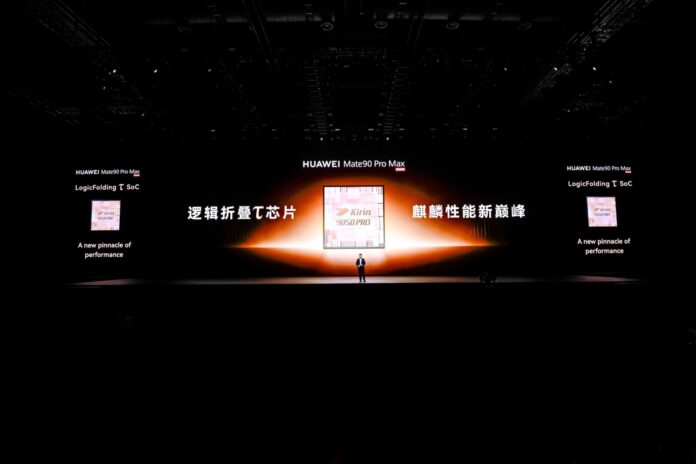
The Mate 90 series smartphones Huawei just launched come with the latest Kirin 9050 Pro chip. The overall device performance is 31% higher than the previous generation. The Balong modem, image sensor processor (ISP), mobile security processor (MSP), Lingxi CPU, Maleoon GPU, and the NPU that adopts Huawei’s Da Vinci architecture for AI processing are all designed by Huawei. They offer higher energy efficiency and deliver much-improved overall system-level performance.
Even though Yu admitted that Huawei has limited access to advanced semiconductor processes, Huawei recently made a new breakthrough in the semiconductor domain – the LogicFolding technology under the Tau Scaling Law. Unveiled by He Tingbo, head of Huawei’s Semiconductor Business Department this May, this technology vertically stacks the logic layers of chips and restructures the circuit layout through inter-layer high-density interconnect to shorten critical paths and reduce latency. This technology was adopted on Kirin 9050 Pro chip, which shows very strong AI processing power. The Mate 90 series powered by this chip can run a 30B MoE on-device AI model.
In the AI domain, Yu talked about the Ascend compute foundation that Huawei provides, by remarking Huawei’s large models called openPangu, AI capabilities for intelligent driving, and HarmonyOS Celia, which is similar to Gemini in the Google Android ecosystem. Huawei is also using AI to improve the O&M of communications network equipment. By combining AI computing power with domestic open-source large models, Huawei’s vision is to help enterprises and industries around the world to become more productive and bringing more convenience to everyone.
In the past years, Huawei has launched a broad series of products and solutions, including smartphones, PCs, tablets, wearables, TWS audio products, Smart TVs, home routers, smart home control solutions, as well as intelligent electric vehicles together with partners. Underlying these products and solutions are Huawei’s chip hardware platform and HarmonyOS – another OS ecosystem after iOS from Apple and Android from Google that Huawei developed to support all the smart devices and smart hardware across all scenarios.
Development of HarmonyOS began in 2019. Before that, Huawei was a major contributor to the Android community as well as the entire Android ecosystem. Now, more than 90 million devices, including smartphones, PCs, and tablets, currently run on HarmonyOS 6 and HarmonyOS 7. This figure is expected to hit the 100 million mark by the end of this year. The number of apps and services in the HarmonyOS ecosystem has already exceeded 450,000. Its global registered developer count has reached 11 million, and Huawei now has over 23,000 app innovation partners. Expressing his special thanks to all partners and developers for their trust and support, Yu also pointed out that Huawei is considering gradually bringing HarmonyOS to the global market in the future.
Globalization is another topic of the conversation. Yu mentioned that Huawei had very good collaboration with many companies from the US, Europe, Japan, South Korea, and Taiwan, delivering huge business value and benefits to those partners. When it comes to the difficulties that Huawei overcame since 2019, Yu said that relying on homegrown technologies and capabilities, Huawei gradually designed its own operating system and developed basic tools and software by themselves, putting a domestic supply chain in place. In 2023, Huawei started to manufacture the chips used by smartphones domestically again. With these chips and HarmonyOS, and by relying on China’s domestic supply chain, materials, and process nodes, Huawei has basically gotten rid of the dependence on US technologies.
While Huawei’s global market share was once No. 1, nowadays it only sells several million units of smartphones outside China every year. However, Yu revealed that Huawei is trying to return to the overseas market step by step.
Taking wearables as an example, Huawei is No. 1 in terms of the market share both in China and globally. Other innovative products such as TWS earphones, are also growing fast and have reached No. 1 in many countries. While Huawei’s tablet and PC business was greatly affected after it was denied access to Windows and Intel x86 chips, the HarmonyOS-based tablets are now performing strongly. Another example would be CPE, which is a mobile router that provides connectivity to the unconnected in remote and rural areas. These products are also very well received across many regions outside China, helping more people connect to the rest of the world and live better lives.
Question: Both the Huawei XT 2 and the two most advanced models of the Mate 90 series use a LogicFolding chip. Will LogicFolding chips be used for more phones in the future? We understand that Huawei’s chip production capacity is still limited. Huawei has launched SuperPoDs, and AI infrastructure is a huge business. They are both very important in China. How do you secure a larger share of the chip supply internally?
Richard Yu: We started introducing the chip that adopts the LogicFolding technology powered by the Tau Scaling Law to the Mate XT 2 tri-fold phone. To answer your question, yes, more of our phones will definitely use these LogicFolding chips in the future.
Currently, the production capacity for advanced semiconductors in China still cannot meet the rapidly growing demand. Huawei’s Ascend chips for the AI domain also use such capacity. But we have developed a requirement plan, which also covers the chip requirements of smartphones.
The sharp price increase for memory components over the past two years has somewhat limited the smartphone sales volume. Even though the production capacity remains tight right now, generally it is sufficient to meet our market shipment needs.
We hope that production capacity will ramp up in China’s semiconductor industry so that we can manufacture more advanced products for consumers in the Chinese market as well as the overseas market in the future.
To read the full Q&A session:
https://www.apmultimedianewsroom.com/multimedia-newsroom/continuous-innovation-securing-our-competitive-edge-through-technological-breakthroughs
Hashtag: #Huawei
The issuer is solely responsible for the content of this announcement.
