

The new release turns a team’s conversations, documents, code, and institutional knowledge into shared memory assets that any agent can draw on.
SHENZHEN, China, Aug. 13, 2026 /PRNewswire/ — Tencent Cloud, the cloud business of global technology company Tencent, today announced that TencentDB Agent Memory, the open-source project from Tencent Cloud Database, has released Team Memory, a major update that extends long-term memory capabilities from individual use to team collaboration.
As team members work alongside agents, the conversations, documents, code repositories, and operational workflows they produce can now be stored as long-term memory, centrally managed, and then assembled based on roles and tasks for different agent platforms such as Tencent CodeBuddy, OpenClaw, and Claude Code.
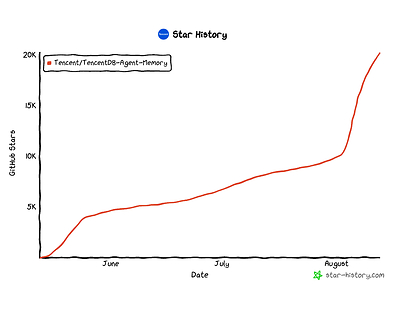
TencentDB Agent Memory was open-sourced in May 2026 to provide both long-term and short-term memory capabilities for agent workflows involving long-running tasks, with support for mainstream agent frameworks. In just 90 days after launch, the project has surpassed 20,000 GitHub stars and reached No. 1 on GitHub Trending multiple times.
Conversations, Documents, Code, and Skills Become Team Memory
Agents are moving quickly to support real-world workflows such as software development and product design, but one-person companies (OPCs) and development teams are also running into new problems: project background has to be explained again and again, past solutions have to be reconstructed, and methods that already work are hard to carry from one agent to the next.
Team Memory was introduced to specifically address these challenges. Unlike earlier releases that focused primarily on preserving historical conversations, Team Memory expands the experience accumulated through team collaboration into four types of structured memory assets.
Historical agent conversations are organized into Chat Memory, project documents are converted into an LLM-Wiki that agents can query in natural language, and code repositories are transformed into a Code Graph to help agents understand code structures, symbol relationships, and call paths. A successfully completed troubleshooting session, requirement breakdown, or code review is distilled into a Skill and reused directly in similar future tasks.
These assets are dynamically assembled based on specific operational roles. For example, an agent responsible for fixing bugs can prioritize the Code Graph, past troubleshooting experience, and relevant Skills, while an agent focused on requirements analysis can load the project wiki, business context, and previous discussions to reduce noise from irrelevant context.
In practice, users set up Team Memory by creating collaborative teams, importing existing assets, and assigning tasks to specific agents. To do this, they first create a Team and agents for different roles, then import code repositories, project documents, and historical agent sessions. When starting a new agent session, users select the Team the task belongs to, the appropriate agent, and the specific task, enabling the system to deliver the appropriate memory assets available to the selected agent and retrieves only the context relevant to the current task.
The accumulated experience in Team Memory remains fully compatible even if the underlying models or agent frameworks change, eliminating the need to rebuild the memory system from scratch.
To lower the barrier to adoption, Team Memory supports a seamless cold start by automatically generating assets from existing repositories and documents. Existing GitHub code and sessions can be imported directly, allowing newly onboarded team members and agents to grasp project contexts with minimal delay.
How Does the New Memory Hub Enable Solo Developers to Manage a Team of Agents?
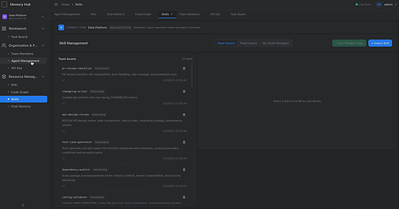
The latest release of Tencent Cloud’s solution introduces the Memory Hub team-memory console, allowing users to create teams, agents, and tasks; consolidate memory assets scattered across conversations, documents, and code repositories; handle generation, review, access control, sharing, and assembly; and view the source, version, and usage of each memory asset.
This management capability addresses multiple collaborative scenarios across different workflows. For a one-person company (OPC) consisting of one human and multiple agents, users can create agents for different roles such as research, development, and review, then configure each one with the documents, code knowledge, historical memory, and skills it requires. Each agent gets what it needs, and the user no longer has to repeat the same background across multiple tools and sessions.
Multi-person teams can leverage this mechanism to seamlessly share knowledge and experiences among human members and digital agents. For example, a troubleshooting skill created by one developer can be reviewed and then shared with other team members and agents. An architecture wiki can also be provided in a consistent way to development, testing, and review agents.
Team Memory substantially enhances governance capabilities to ensure secure and efficient asset management within collaborative environments. For example, each memory item supports management of its owner, version, status, and usage history, and permissions can be configured by user, role, and agent. Sharing scopes can range from private to team-wide, with authorized access for designated users or agents, keeping data isolated while enabling teams to leverage collective experience.
Designed as a specialized team memory layer, Team Memory operates between agents and large language models (LLMs) rather than acting as an independent agent. Its role is to preserve conversations, knowledge, code, and working experience, and deliver the right memory to the right agent in the next task.
For more new features in Team Memory, feel free to install and try it out, and you are also welcome to star the project or submit an issue. Memory project homepage: https://github.com/TencentCloud/TencentDB-Agent-Memory
About Tencent Cloud
Tencent Cloud is one of the world’s fastest-growing cloud service providers, committed to delivering innovative solutions that address everyday life and business challenges, and empowering the digital transformation of smart industries. Tencent Cloud has always upheld its mission to meet the needs of every industry, leveraging cloud computing, Big Data analytics, AI, IoT and cybersecurity, together with its extensive global infrastructure, to provide businesses with stable, secure and industry-leading cloud products and services across a wide range of sectors, including education, finance, healthcare, gaming, media and entertainment, property, retail, travel and transportation.
 View original content to download multimedia:https://www.prnewswire.com/apac/news-releases/tencentdb-agent-memory-tops-20-000-github-stars-in-90-days-launches-team-memory-for-multi-agent-collaboration-302850576.html
SOURCE Tencent Cloud
